Toyota’s Asset Backed Green Bond: This Is Big
Sean Kidney Toyota Motor Corp. (NYSE:TM) will close mid-next week on what will be the world’s first green bond backed by auto loans – electric vehicle and hybrid car loans to be specific. And what a kickstart for that market, at $1.75 billion. According to a report in International Financing Review (IFR), the bond will be in multiple tranches, each at a different ratings level: A2 tranche, A3 and A4 (Moody’s ratings). First thing to know: they told the media a week ago it would be a US$774.675 million bond. Rumour has it that initial investor interest...
Trina Solar’s Second Convertible Bond
By Beate Sonerud and Sean Kidney China’s Trina Solar (TSL)is issuing US$100m of convertible bonds with 5-year tenor and 4% annual coupon, with semi-annual payments. An extra US$15m could be raised, as Trina has given the underwriters a 1-month window to buy additional bonds. Guess they are waiting to gauge demand. Underwriters are Deutsche Bank, Barclays, and Credit Suisse, with Roth Capital Partners as co-manager. The bonds can be converted to shares (American Depositary Shares, meaning they are listed in the US) at an initial price of US$14.69 per share. Currently, Trina’s shares are trading at US$11.40, after...
Hannon Armstrong Yeild On Track For 7% in Q4 With More To Come
Tom Konrad CFA After the close on Thursday, November 7th, Hannon Armstrong Sustainable Infrastructure Capital (NYSE:HASI) declared third quarter earnings. Results were in-line with my, and other analysts’ expectations: Earnings per share (EPS) of 14 cents, and a declared dividend of 14 cents as well. This more than doubled the second quarter’s 7 cent EPS and 6 cent dividend. Note: I have a large long position in HASI. HASI remains on track to reach managements’ dividend target of “over 7% of the $12.50 IPO price” (22 cents a quarter,) and provided some additional guidance for future dividends....
SolarCity’s Second Solar Lease-Backed Bond Closes Thursday
SolarCity is on the road with a $70.2m, 8yr, BBB+ rooftop solar leases securitization; closes Thursday Sean Kidney US company SolarCity (NASD:SCTY) has priced a solar bond backed by cash flows from a pool of 6,596 mainly residential solar panel systems and power purchase agreements in California, Arizona, and Colorado. Expected bond figure is $70.2 million, but the bond doesn’t close until Thursday this week. Interest rate is 4.59%. Credit Suisse is structurer and sole bookrunner. This is SolarCity’s second solar securitization in six months. Their previous (ground-breaking) bond was for $54.4 million with an...
10 Clean Energy Stocks for 2020: Updates on GPP, HASI, CVA
by Tom Konrad, Ph.D., CFA
Market Decline
Last week I warned "The risks in today's stock market outweigh the possibility of future potential gains." Looks like we're seeing those risks manifest in short order. The last couple days' decline have me looking at a few stocks to start adding to my positions again, especially MiX Telematics (MIXT) discussed on June 2nd and Green Plain Partners (GPP), discussed below.
Note that this pullback could easily be very early days of a much larger market decline. We might even see the market fall far enough to test the March lows... any of my buying...
Pattern Energy Investors Enjoy The Breeze
by Debra Fiakas CFA This week Pattern Energy Group’s (PEGI: Nasdaq), the independent wind power generator, is scheduled to report sales and earnings for the quarter ending September 2015. The company has cultivated a strong following among analysts for a company its size. Nine estimate contributions have gone into a consensus estimate of $87.2 million in sales for the quarter, resulting in a net loss of a penny per share. If achieved the sales hurdle would represent 22% growth over the same quarter last year. A penny loss may not seem impressive, but it is substantially better than...
One Week, Three YieldCo Deals. Are More Buyouts on the Horizon?
by Tom Konrad, Ph.D., CFA
It's been a busy several days in the YieldCo space.
On February 5, 8point3 Energy Partners (NASD:CAFD) announced an agreement to be acquired by an infrastructure investment fund managed by Capital Dynamics. While I was still writing an article on why the sale price was at a virtually unheard of discount relative to the stock market price, two more YieldCo deals were announced: NRG Energy (NYSE:NRG) agreed to sell its sponsorship stake in NRG Yield (NYSE:NYLD and NYSE:NYLD/A) to Global Infrastructure Partners, and YieldCo TerraForm Power (NASD:TERP) made an offer to buy out Spanish YieldCo Saeta Yield (Madrid:SAY) at a 20 percent...
Q1 Earnings Roundup: Yieldcos (AGR, BEP, CWEN, GPP)
By Tom Konrad, Ph.D., CFA
This is a roundup of first quarter earnings notes shared with my Patreon supporters over the last week. If there is any theme, it’s that low interest rates and increased interest in green investments is lowering Yieldcos’ cost of capital to the benefit of stock investors.
Avangrid Earnings
Avangrid's (AGR) Q1 earnings report showed solid progress. Key items of note were:
Increased outlook for full year 2021 Adjusted EPS a little over 5%
Key environmental approval for 800 MW offshore wind farm Vineyard Wind. Expected to begin construction later this year, with expected completion in 2024. Avangrid...
Northland Power’s Solar-Backed Bond
New Canadian Climate bond: Northland Power releases a pretty big ABS - CA$232m (US$206m) - backed by solar projects with proceeds for renewables. 18-year tenor, 4.397% coupon, BBB. Securitisation key future area for green bonds.
Nordex Issues First Green Schuldschein
by the Climate Bonds Team German green debt instrument raises €550m ($621m) for wind energy and gains Climate Bonds Certification. German wind company Nordex (NRDXF) is the first Schuldschein issuer to label its issue as green. The green issue is verified under the Climate Bonds Standard and sector specific Wind Standard. Assets include wind power manufacturing and infrastructure around the world. Nordex employed DNV GL to verify the green Schuldschein against the Climate Bonds Standard. The deal was split across four tranches with 3, 5, 7 and 10 year tenors. The joint underwriters were...
My Yieldco Raised Its Dividend With This Weird Trick
Tom Konrad CFA Clean energy yieldcos buck the general trend by paying out a large proportion of cash flow to investors, and rapidly increasing their dividends at the same time. The key to this trick has been their rapidly appreciating stock prices. High yield companies generally grow slowly, while high growth companies have low dividend yields. Normal companies grow by investing some profits in new business opportunities. Early stage growth companies typically retain all their earnings to invest in new business. More mature companies have fewer opportunities, and so share a larger proportion of...
The Sustainable Infrastructure Income Trust
Tom Konrad CFA Jeffrey Eckel Jeffrey Eckel has an investor relations problem. No, there has not been any scandal involving fudging the books or sweatshop labor. Rather, most investors simply don’t seem to “get” his company. His company recently went public as a REIT, or Real Estate Investment Trust, and the traditional REIT investor likes the familiar. They invest for income, and for many, a track record of past income and dividends is a must. While Eckel’s company manages $1.8 billion of securitized energy efficient and sustainable infrastructure...
Five Green Dividend Stocks to Watch
Tom Konrad CFA The Perfect Stock My ideal stock is: Green (in that the company is helping to make the economy more sustainable) Pays a good dividend (in the current low-interest rate environment, I consider 4% to be “good”) Has earnings and free cash flow large enough to easily sustain the dividend, and Has low debt, leading to low earnings and cash flow volatility. I like such stocks because I can buy them, and pretty much ignore them. This leaves me time to research more speculative green stocks, while still knowing that much of my portfolio is producing...
Buyer’s Guide To Community Solar in New York
by Tom Konrad Ph.D., CFA
An updated version of this article is available here.
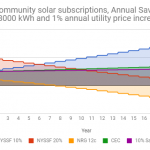
After a painfully long wait, community solar (also called shared solar) is finally coming to New York state. After years of regulatory uncertainty, the state Public Services Commission (PSC) has put enough of the enabling regulations in place for a number of developers to move forward.
What is Community Solar?
A community solar installation is a large scale (typically 1 to 3 MW, or the size of about 150 to 800 residential solar installations) in which subscribers can sign up to lease or purchase a share of the production...
Green Bonds: 2015 Year End Review
by the Climate Bonds Team Another successful year for the green bond market with 2015 issuance hitting $41.8bn making it the biggest year ever for green bonds. Achieving scale hasn’t been the only reason to celebrate the green bond market at the year-end; the real success is the geographical spread of green bonds across the world. Green bond markets are popping up all across the world, in Brazil, China, Estonia, Mexico and India… just to name a few! Green bond market momentum continues to build after a successful COP in Paris. ...
Fossil Fuel Companies Should Be Issuing Green Bonds
by the Climate Bonds Team ‘Fossil fuel companies should not be issuing green bonds because they are not green businesses.’ Varying versions of this statement crops up often at green bond conferences and in articles. We disagree, and here is why: It’s use of proceeds that matter Green bonds are about use of proceeds. What matters is the green characteristics and features of the projects that are being invested in, the ‘use of proceeds’, not the balance sheet backing the bond. This is an accepted concept in the green bond market...